
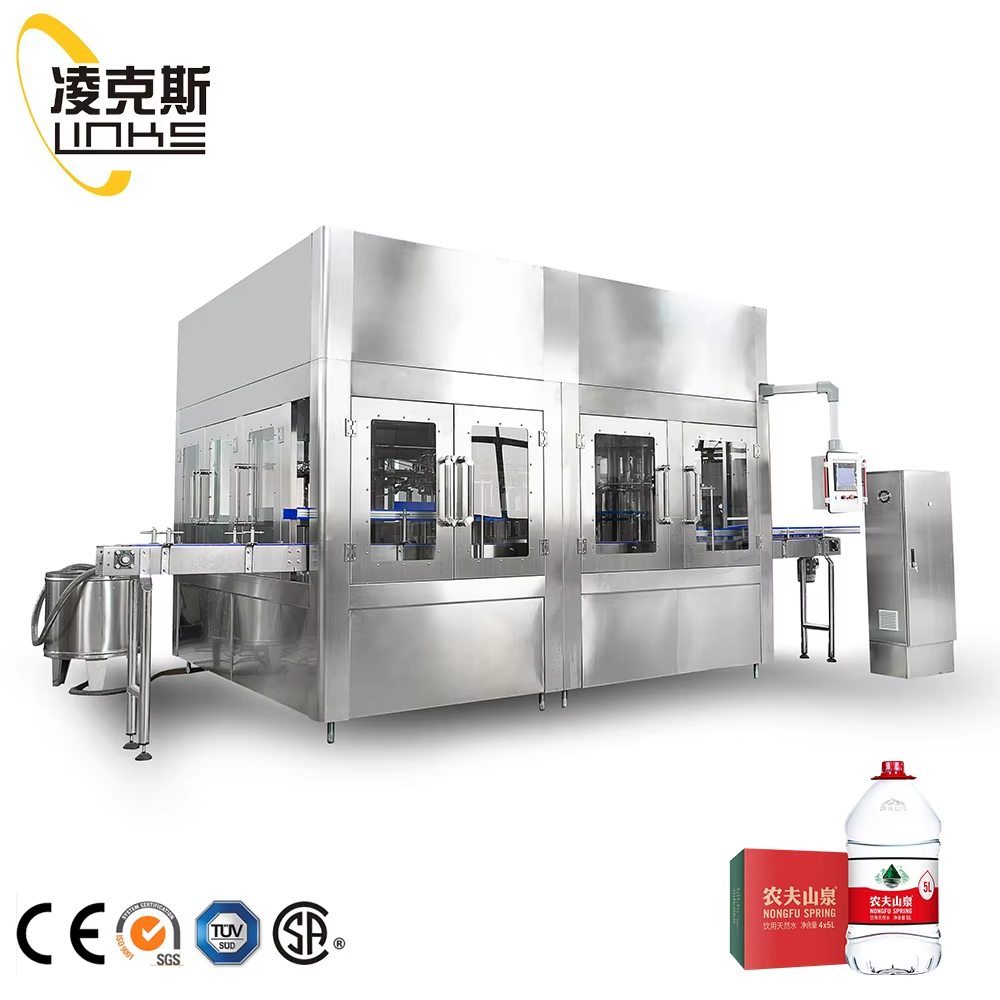
How Automatic Blowing Machines Drive Efficient PET Bottle Production
Stretch Blow Molding Workflow: Preform Heating, Axial Stretching, and High-Pressure Air Blowing
The heart of an automatic blowing machine lies in its precisely sequenced stretch blow molding process. Preforms are fed into a conditioning oven where infrared emitters raise the PET material to its glass transition temperature—softening it just enough for uniform expansion. The heated preform then moves to the blow mold station, where a servo-driven stretch rod initiates axial stretching to define bottle length, while high-pressure air (often exceeding 30 bar) is injected radially through the rod’s nozzle. This dual-action stretching ensures consistent wall thickness and eliminates structural weak points. Modern machines execute these steps at speeds up to 2,000 bottles per cavity per hour—cutting cycle times significantly versus semi-automated alternatives—while maintaining dimensional accuracy and structural integrity across long production runs.
Core Engineering Factors: Preform Compatibility, Thermal Uniformity, and Servo-Controlled Stretch Rod Dynamics
Three engineering pillars determine output quality and uptime. First, preform compatibility: mandrel geometry, neck-clamping force, and oven thermal profile must match the preform’s weight, wall thickness, and intrinsic viscosity; mismatches cause uneven expansion or stress fractures. Second, thermal uniformity: advanced IR lamps with reflective backplanes and closed-loop temperature control limit deviation to ±1°C across the preform body—preventing hot spots that compromise burst resistance and top-load strength. Third, servo-controlled stretch rod dynamics enable precise tuning of acceleration, depth, and dwell time, allowing operators to optimize stretch rate for varied neck finishes and bottle geometries—eliminating base thinning and improving material distribution. Together, these factors sustain high throughput with minimal scrap, making engineering fidelity as critical as nominal speed.
Critical Performance Features of Modern Automatic Blowing Machines
Precision Motion Control: Servo-Driven Clamping, Stretching, and Blowing Sequences
Modern automatic blowing machines replace hydraulic or pneumatic actuators with servo motors, delivering sub-millimeter repeatability across clamping, stretching, and air injection. The clamping unit applies consistent mold-closing force to prevent flash and misalignment. The stretch rod advances with programmable velocity profiles, ensuring controlled elongation that optimizes material flow. High-pressure air injection follows a tightly timed sequence—stabilizing the parison before final inflation—to eliminate overshoot and ensure uniform wall thickness, especially vital for lightweight bottles requiring high top-load resistance. According to a 2023 industry benchmark study of high-speed lines, servo-driven systems reduce cycle-to-cycle variation by up to 40% compared to legacy cam-driven designs, directly improving consistency and lowering scrap rates. Integrated motion controllers also adapt in real time to preform temperature fluctuations—maintaining quality without manual intervention.
Energy Optimization: Advanced IR+Convection Heating vs. Legacy Lamps — 22% Lower kWh/Bottle
Heating accounts for over 60% of a blowing machine’s energy use. Traditional quartz lamps suffer from scattered radiation, slow warm-up, and continuous operation—even during idle periods. Newer systems combine short-wave infrared (IR) emitters with forced convection to concentrate heat precisely on the preform while minimizing ambient loss. Intelligent power management modulates lamp output based on real-time preform temperature feedback, holding the oven at the exact thermal setpoint. This dual-mode approach achieves a documented 22% reduction in kWh per bottle, lowering both operating costs and carbon emissions. Convection also accelerates temperature equalization across the preform wall, reducing soak time and enabling faster cycle rates. As a result, manufacturers meet sustainability targets without compromising output—and reduced thermal load extends service intervals for machine components.
Industry-Specific Applications Enabled by Automatic Blowing Machines
Beverage Sector Dominance: 92% of Global PET Water Bottles Produced on Fully Automatic Lines
The beverage sector relies almost exclusively on fully automatic blowing machines: approximately 92% of global PET water bottles are produced on such lines. A single modern line can output over 72,000 bottles per hour—supporting demand for bottled water, carbonated soft drinks, and juices. This dominance stems from the technology’s ability to produce lightweight, structurally robust containers with precise neck finishes and uniform wall thickness—ensuring leak-proof seals and seamless integration with high-speed filling lines. By minimizing manual handling, automated lines also reduce contamination risk and labor costs while sustaining the throughput essential for large-scale operations.
Beyond Beverages: Customization Capabilities for Cosmetics, Pharma, and Household Packaging
Automatic blowing machines support diverse sectors beyond beverages. In cosmetics, they produce brand-distinguishing shapes—oval, tapered, or asymmetrical—with high-gloss surfaces and wide labeling panels. In pharmaceuticals, sterile environments and validated processes yield containers for syrups, nasal sprays, and liquid medicines, meeting stringent cleanliness and regulatory requirements. For household chemicals and personal care products, the same platform forms robust HDPE and PP bottles with ergonomic grips, spray-trigger necks, and tamper-evident features. Rapid mold-change systems—enabling three-minute changeovers—make short-run custom lots economically viable without sacrificing consistency or durability across industries.
Selecting the Right Automatic Blowing Machine: Capacity, Flexibility, and TCO
Choosing the right automatic blowing machine requires balancing production capacity, operational flexibility, and total cost of ownership (TCO)—not just upfront price. A misstep can lock in years of avoidable energy waste or unplanned downtime. Start with a precise volume calculation:
Required BPH = (Annual target in bottles) ÷ (Operating days × Hours per day × 0.85 utilization).
For a plant targeting 10 million bottles annually, running 300 days at 16 hours/day, the minimum sustained output is roughly 2,450 bottles per hour (BPH)—immediately narrowing viable machine categories.
Flexibility is equally decisive. The machine must handle your specific preform weights and neck finishes—for example, a 10–18 g preform for a 500 ml bottle with a 28 mm neck. Tooling mismatches drive scrap and rework, eroding any capital savings. If you run multiple bottle formats, prioritize rapid changeover capability: tool-free mold systems cut downtime by up to 40% versus manual adjustments.
TCO analysis often reveals that lower purchase price doesn’t mean lower cost per bottle. The table below reflects typical 2026 industry estimates for three machine categories, highlighting how labor, energy, and maintenance differences compound over five years.
| Machine Type | Typical Capacity (BPH) | Approx. Investment (2026) | 5‑Year TCO per 1,000 bottles |
|---|---|---|---|
| Semi‑Automatic (2‑cavity) | 800–1,500 | $29,000–$55,000 | $1.17 |
| Linear Automatic (4‑cavity) | 2,000–5,000 | $77,000–$139,000 | $0.80 |
| High‑Speed Rotary (6‑cavity+) | 6,000–36,000 | $185,000–$380,000 | Variable, lowest at scale |
The linear automatic machine delivers a 32% lower per-unit cost than the semi-automatic alternative over five years—primarily because one operator can supervise the entire line instead of manually loading each cycle. Rotary systems further reduce unit cost for high-volume beverage plants, though their capital outlay and facility footprint are significantly greater.
A frequently overlooked TCO factor is compressed air infrastructure. Every stretch blow molding machine requires clean, oil-free air at 25–40 bar. A dedicated screw compressor and refrigerated dryer can add $4,000 to $60,000 to the total investment—depending on the machine’s air consumption (0.4–12.0 Nm³/min). Always request a complete system quote that includes auxiliary equipment to avoid costly post-installation surprises. By aligning your calculated BPH with the appropriate machine class, verifying preform compatibility, and modeling the full five-year cost picture—including energy, labor, and infrastructure—you select a solution that supports current needs and scalable growth.
Frequently Asked Questions
What is the stretch blow molding process?
The stretch blow molding process is a manufacturing technique used to produce PET bottles. It involves heating preforms to their glass transition temperature, axial stretching with a stretch rod, and high-pressure air blowing to achieve the desired shape and uniform wall thickness.
Why are servo motors preferred in modern automatic blowing machines?
Servo motors are preferred because they provide sub-millimeter repeatability and precise motion control during clamping, stretching, and air blowing sequences. They reduce cycle-to-cycle variation and ensure consistent bottle quality while lowering scrap rates.
How do automatic blowing machines save energy?
Automatic blowing machines save energy by utilizing advanced short-wave IR emitters combined with forced convection. This dual-mode heating system minimizes ambient energy loss and intelligently modulates power based on real-time temperature feedback, reducing kWh per bottle by up to 22%.
What industries use automatic blowing machines?
Automatic blowing machines are widely used in the beverage industry, as well as in industries producing cosmetics, pharmaceuticals, household chemicals, and personal care products. They enable high-speed production and versatile customization of PET bottles and containers.
What factors should I consider when selecting an automatic blowing machine?
Key factors to consider include production capacity (measured in bottles per hour), tooling flexibility to handle varied preforms and formats, and total cost of ownership (TCO), which accounts for energy use, labor, maintenance, and auxiliary equipment like air compressors.
Table of Contents
- How Automatic Blowing Machines Drive Efficient PET Bottle Production
- Critical Performance Features of Modern Automatic Blowing Machines
- Industry-Specific Applications Enabled by Automatic Blowing Machines
- Selecting the Right Automatic Blowing Machine: Capacity, Flexibility, and TCO
- Frequently Asked Questions