
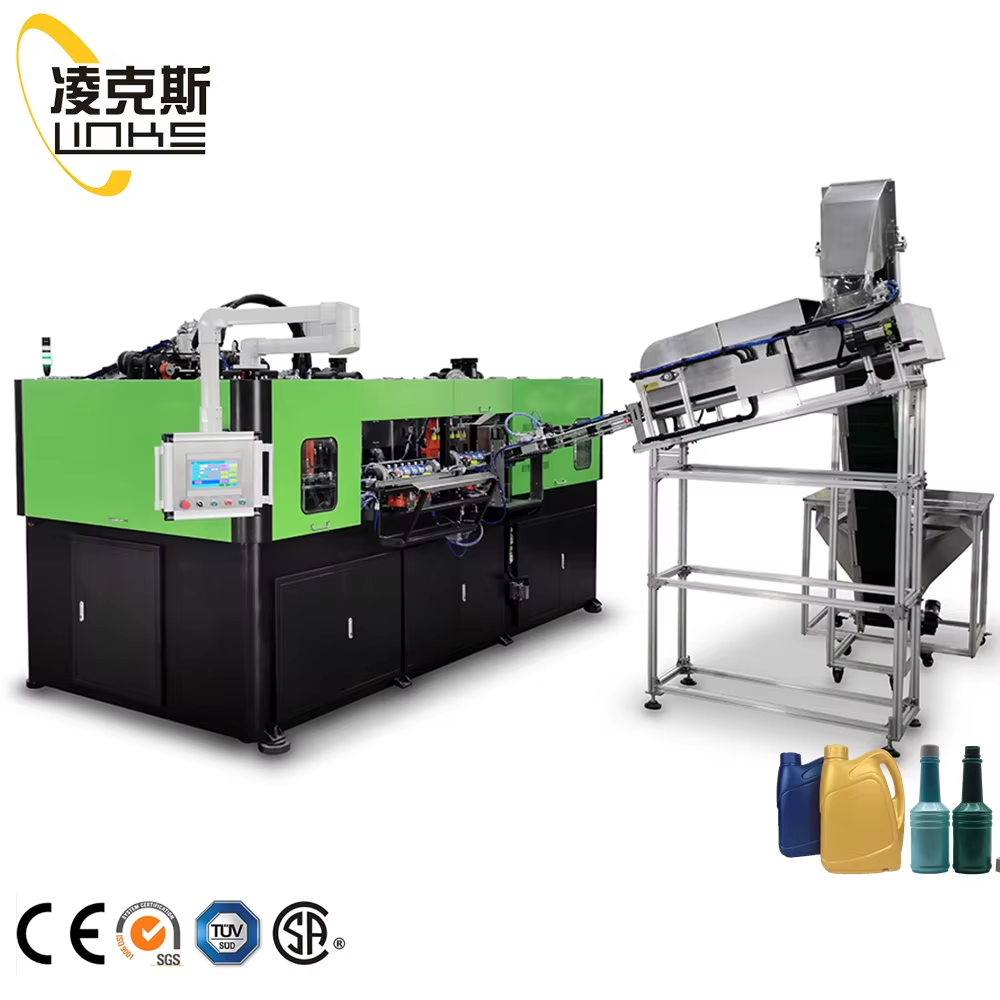
Single-Platform Versatility: Handling 5 mL to 40 L Bottles
Dynamic Parameter Scaling Across Micro- to Macro-Scale Production
Modern blowing machines achieve true single-platform versatility by dynamically scaling process parameters across an extreme 5 mL to 40 L range. Rather than requiring separate mechanical setups, the system automatically adjusts critical variables—preform heating time, stretch rod speed, blow pressure, and mold cooling—based on preform geometry and target container dimensions. The table below illustrates how key parameters are recalibrated for micro-scale versus large-format production.
| Parameter | 5 mL Dropper Bottle | 40 L Industrial Drum | Scaling Method |
|---|---|---|---|
| Preform heating time | 4–8 s | 120–180 s | Infrared oven zone length & power modulation |
| Stretch rod speed | 1.5–2.0 m/s | 0.3–0.5 m/s | Servo-driven stroke with force feedback |
| Blow pressure | 8–12 bar | 30–35 bar | Multi-stage pressure control with high-flow valves |
| Mold cooling time | 1.5–2.5 s | 25–35 s | Adaptive chiller capacity and channel design |
This scaling relies on a unified control architecture that stores over 200 recipe-driven profiles. Servo-actuators and linear motors deliver sub-millimeter precision for small medical containers while generating the torque required for thick-walled 40 L drums. By eliminating manual recalibration, producers reduce changeover-related downtime by up to 60% and maintain consistent wall thickness across the entire product range.
Integrated Thermal and Pressure Adaptation for Seamless Transitions
Transitioning from a 5 mL eye-dropper to a 40 L jerrycan without sacrificing quality demands intelligent thermal and pressure adaptation. Real-time infrared pyrometry and cavity-pressure sensors feed a closed-loop controller that adjusts heating profiles and blow-pressure curves in milliseconds. For small, thin-walled bottles, the system applies a gentle pre-blow at 6–8 bar to prevent over-stretching; for large containers, it switches to a high-pressure final blow (up to 35 bar) with a precisely timed delay to ensure uniform material distribution.
This adaptive logic extends to material-specific behaviors. With recycled PET (rPET), for instance, the machine automatically increases oven temperature by 5–8% and extends the conditioning phase to compensate for lower intrinsic viscosity. As a result, a single platform can handle over 50 different bottle shapes and sizes per day while maintaining a first-pass yield above 98%, regardless of container volume.
Cross-Industry Bottle Compatibility: Beverage, Cosmetic, and Pharmaceutical Applications
Neck Finish Flexibility Ensuring Functional & Regulatory Compliance
A single blowing machine must adapt to widely divergent neck-finish geometries and closure systems without sacrificing consistency. Beverage lines commonly demand snap-on or pilfer-proof 28-mm PCO necks capable of withstanding carbonation pressure, while cosmetic packs rely on 24/410 or 18/415 threaded finishes to accommodate dose-controlled pumps and flip-caps. Pharmaceutical applications require child-resistant or tamper-evident seals—and strict compliance with ISO 8317 and USP <671>. Modern systems achieve this through precision-guided stretch-rod movement and independently programmable clamp pressure that holds the neck ring within microns of tolerance. A recent field audit of 12 multi-SKU co-packers showed that neck-finish-related leakage dropped by 40% when closed-loop parison-centering feedback was introduced (Packaging Consortium Study, 2023). By storing validated recipes for each neck profile—including pre-blow timing, stretch-rod delay, and final blow pressure—the machine ensures dimensional accuracy is identical whether producing a 5 mL pharmaceutical dropper or a 2 L sports-cap bottle.
Material-Optimized Heating Profiles for PET, rPET, and Bio-Based PLA
Cross-industry compatibility also hinges on thermal-control intelligence. Virgin PET responds best to short-wave IR lamps and rapid, uniform reheating within its narrow surface temperature window (95–115 °C), preserving intrinsic viscosity. When switching to 100% rPET, the same machine slows the heat-soak phase and applies a gentler ramp to avoid thermal-oxidative degradation—an adjustment critical for preventing acetaldehyde spikes that affect beverage taste. For bio-based PLA, the heating profile shifts lower (85–100 °C), with modulated lamp intensity throughout the cycle to accommodate slower crystallization kinetics. By recalling these distinct, material-specific heating curves, manufacturers eliminate trial-and-error changeovers. One dairy operation reported a 65% reduction in scrap when shifting from virgin PET yogurt bottles to rPET supplement containers—simply by loading a validated thermal recipe. This built-in adaptability enables seamless service across the carbonation-focused beverage sector, sustainability-driven cosmetics market, and purity-critical pharmaceutical field.
Rapid Mold Changeover with Modular Quick-Change Systems
Modular Mold Carriers Enabling <8-Minute Size/Shape Transitions
Modern blowing machines use modular mold carrier designs that reduce size- and shape-change times to under eight minutes. Traditional mold changes often required 30–60 minutes of manual realignment and utility reconnection, but today’s quick-change systems integrate pre-aligned clamping interfaces, standardized quick-connectors for cooling and air lines, and automated alignment verification. Hydraulic or magnetic clamps apply uniform securing force, while digital sensors confirm proper positioning—minimizing setup errors. This capability is essential for high-mix production, allowing manufacturers to maintain continuous output and respond rapidly to shifting market demands—without compromising blow molding quality.
Precision Process Control for Consistent Blow Molding Quality
To ensure uniform bottle quality across sizes spanning 5 mL vials to 40 L industrial drums, the blowing machine relies on closed-loop process control. Real-time sensors monitor blow pressure, preform temperature, and cooling rates, feeding data to adaptive algorithms that micro-adjust every cycle. This tight regulation eliminates fluctuations common in high-mix environments. Advanced parison control delivers even wall thickness despite sudden geometry changes—reducing material waste and preventing structural weak points. Digital servo drives replace legacy mechanical cams, enabling repeatable stretch-rod positioning and mold closure within micron-level tolerances. A comprehensive study found that intelligent feedback loops drive defect rates below 0.5% (Packaging Innovation Institute, 2022). Temperature management is equally precise: zoned infrared heaters and instant cooling adaptation maintain optimal material viscosity whether processing virgin PET or bio-based PLA. In-line inspection stations automatically flag and reject non-conforming units before they reach downstream automation—preserving end-to-end quality integrity. This self-correcting architecture transforms the blowing machine into a stable, repeatable production cell that delivers identical bottle integrity batch after batch—even during rapid mold changeovers and extreme size-shift operations.
FAQ
What is the purpose of dynamic parameter scaling in modern blowing machines?
Dynamic parameter scaling adjusts critical aspects such as preform heating, stretch rod speed, and blow pressure to handle various bottle sizes (from 5 mL to 40 L) on a single platform without manually changing equipment setups.
How does integrated thermal and pressure adaptation work?
Real-time sensors and a closed-loop controller regulate heating profiles and blow-pressure curves, allowing the machine to adapt instantly to different bottle sizes and materials for consistent quality.
What industries benefit from cross-industry bottle compatibility?
Industries such as beverage, cosmetics, and pharmaceuticals benefit from bottle compatibility, with machines designed to handle specific neck finishes, regulatory demands, and material behaviors efficiently.
What are the advantages of modular quick-change systems?
Modular quick-change systems reduce size and shape changeover times to under eight minutes, ensuring minimal downtime and optimal production efficiency in high-mix environments.
How does precision process control maintain consistent quality?
Closed-loop systems monitor key parameters in real-time, ensuring consistent material distribution, uniform wall thickness, and low defect rates, even during rapid mold changes or extreme size transitions.
Table of Contents
- Single-Platform Versatility: Handling 5 mL to 40 L Bottles
- Cross-Industry Bottle Compatibility: Beverage, Cosmetic, and Pharmaceutical Applications
- Rapid Mold Changeover with Modular Quick-Change Systems
- Precision Process Control for Consistent Blow Molding Quality
-
FAQ
- What is the purpose of dynamic parameter scaling in modern blowing machines?
- How does integrated thermal and pressure adaptation work?
- What industries benefit from cross-industry bottle compatibility?
- What are the advantages of modular quick-change systems?
- How does precision process control maintain consistent quality?