
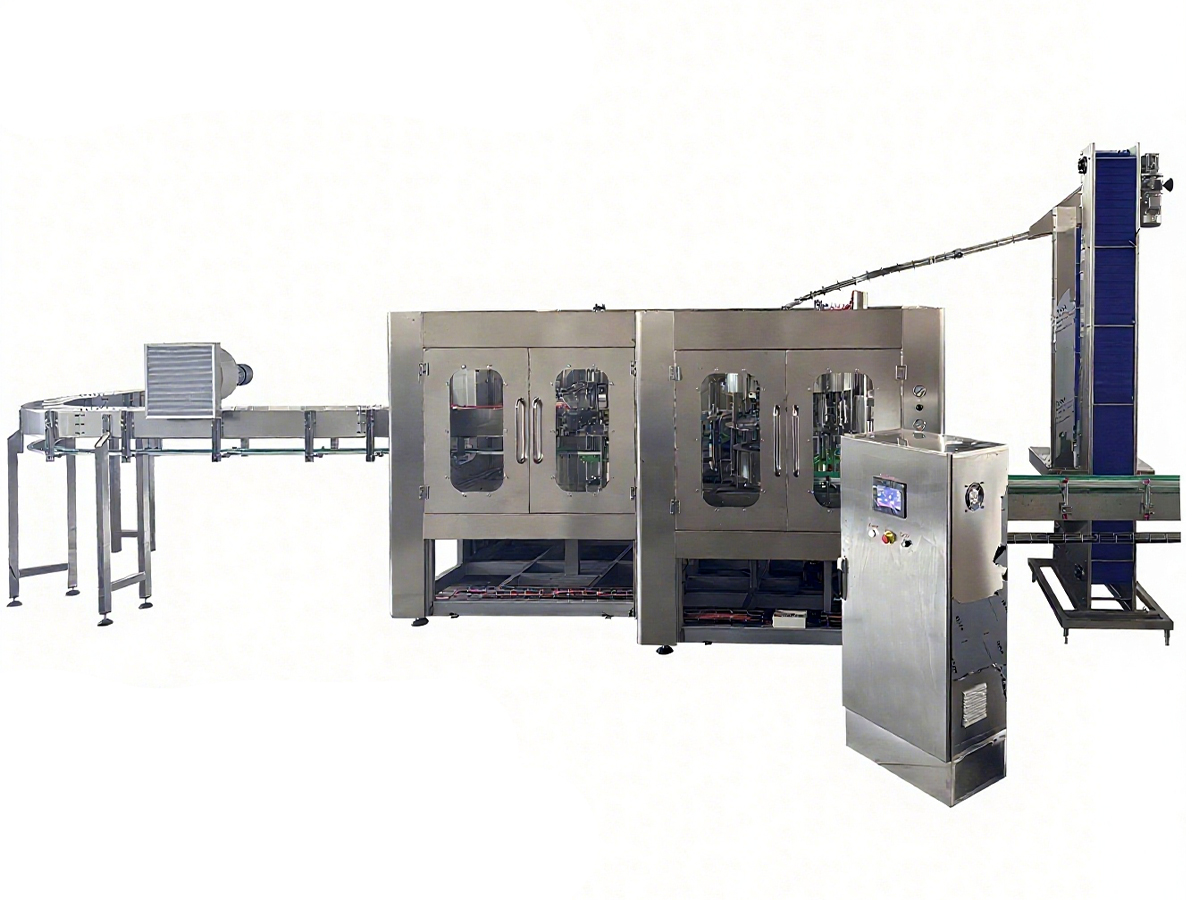
Volumetric Filling Technology for Consistent Soft Drinks Bottling
How Volumetric Pumps Deliver ±0.3% Fill Accuracy Across Carbonated and Non-Carbonated Soft Drinks
Volumetric pumps ensure precise fill volumes by trapping a fixed amount of liquid in a sealed chamber and displacing it into each container—regardless of whether the beverage is carbonated or still. Piston, rotary, and peristaltic designs all achieve ±0.3% accuracy under real-world production conditions (2023). For carbonated drinks, the system mitigates foaming through controlled fill speed and regulated backpressure, preserving volume consistency despite CO₂ release. Non-carbonated products benefit from the same mechanical repeatability, with no need for density-based recalibration. This precision limits product giveaway to less than 1.2 mL per 400 mL bottle—translating to up to $740k in annual savings for large-scale producers (Ponemon 2023). Advanced systems also auto-compensate for temperature and viscosity shifts, ensuring every bottle meets labeled volume targets. Whether filling glass or PET containers, volumetric filling prioritizes exact dosage over visual fill height—reducing waste and minimizing regulatory exposure.
Calibration, Sensor Integration, and Batch-to-Batch Consistency in High-Speed Soft Drinks Bottling
Sustaining ±0.3% accuracy at high speeds requires rigorous calibration and intelligent sensor feedback. Before each run, operators verify piston stroke length or rotary valve timing against certified reference volumes. Inline mass flow meters and laser sensors continuously monitor fill weight and volume, feeding data to a central controller. If deviations exceed preset thresholds, the system adjusts fill parameters in real time—without halting production. This closed-loop control maintains batch-to-batch consistency even amid changing ambient conditions or recipe adjustments: for instance, increased syrup concentration alters viscosity, prompting micro-adjustments to piston displacement. Calibration cycles are triggered automatically—by bottle count or time interval—to prevent drift. Integrated diagnostics also detect early signs of wear, such as seal degradation or valve leakage, enabling predictive maintenance. The outcome is a stable, self-correcting process where every bottle—from the first to the millionth—meets identical volume specifications, reinforcing consumer trust and regulatory compliance.
Automated Control Systems Enhancing Speed and Precision in Soft Drinks Bottling
In modern soft drinks bottling, automated control systems serve as the central nervous system—integrating hardware and software to sustain quality, speed, and consistency across the entire line.
PLC-Driven Synchronization of Conveyor, Capping, and Filling for Seamless Soft Drinks Bottling Lines
Programmable Logic Controllers (PLCs) coordinate conveyors, fillers, and cappers with microsecond-level timing, ensuring each bottle arrives at the filling valve precisely when required, receives its programmed volume, and advances smoothly to capping. On high-speed lines exceeding 1,000 bottles per minute, this synchronization prevents jams, misfeeds, and collisions—common sources of unplanned downtime. According to the International Society of Automation (ISA), PLC-driven control reduces line stoppages by up to 35% compared to legacy relay-based systems (ISA 2023). Dynamic motion control algorithms further optimize acceleration and deceleration profiles, eliminating bottle tipping and spillage. The result is seamless integration across filler, capper, and labeler—boosting throughput and improving Overall Equipment Effectiveness (OEE) by 12–15% (Packaging Digest 2024). Consistent timing also ensures uniform cap torque application, critical for preserving carbonation integrity and preventing leaks.
Real-Time Monitoring and Adaptive Adjustment to Maintain Fill Consistency Under Variable Line Speeds
Real-time monitoring systems deploy networks of pressure, flow, and level sensors to continuously track fill performance. Data streams to a central processor that identifies deviations within milliseconds. When line speeds fluctuate—due to upstream supply variance or downstream packaging delays—adaptive algorithms instantly adjust pump speed and fill valve timing to preserve accuracy. A 2024 Beverage Technology Institute study confirmed these systems maintain fill consistency within ±0.5% even during 25% line speed variations (BTI 2024). This responsiveness is especially vital for carbonated beverages, where pressure shifts can trigger foaming and inaccurate fills. Predictive analytics anticipate drift before it impacts output, scheduling subtle corrections proactively. Operators receive actionable alerts via dashboard interfaces, allowing rapid intervention when needed. Continuous adaptive control ensures every bottle hits target volume—minimizing overfills and underfills, reducing waste, and protecting brand reputation and regulatory standing.
Integrated Quality Assurance for Hygienic and Compliant Soft Drinks Bottling
Industrial Vision Systems for Cap Integrity, Fill Level, and Label Verification in Soft Drinks Bottling
Multi-camera industrial vision systems perform real-time, non-contact inspection of every bottle—verifying cap placement (including tilt and tamper-band integrity), fill level to ±1 mm, and label alignment and content accuracy. Using high-intensity illumination and AI-powered defect recognition, these systems detect subtle flaws like misprinted date codes or incomplete seals. Capable of inspecting up to 1,200 bottles per minute, they achieve a false reject rate below 0.01% (Food Engineering 2023). Detected defects trigger automatic ejection—without disrupting line flow. This tightly integrated QA layer safeguards brand equity, prevents costly recalls, and ensures compliance with global food safety standards.
Food-Grade Sensors and Clean-in-Place (CIP) Compatibility Ensuring Regulatory Compliance
All product-contact components—including sensors, valves, and piping—are constructed from FDA 21 CFR– and EU Regulation 1935/2004–compliant materials. Clean-in-Place (CIP) systems automate sanitation of fill heads, manifolds, and tanks using heated, turbulent cleaning solutions—no disassembly required. CIP-compatible sensors withstand spray pressures and temperatures up to 95°C, meeting EHEDG hygiene guidelines. This design enables full validation of cleaning efficacy, rapid flavor changeovers, and continuous adherence to food safety regulations—without compromising line uptime or product integrity.
Frequently Asked Questions (FAQ)
What is volumetric filling, and how does it work?
Volumetric filling is a process where a fixed amount of liquid is trapped in a sealed chamber and displaced into a container. This ensures precise volume measurement regardless of carbonation or density variations.
How does volumetric filling ensure accuracy for carbonated beverages?
The system uses controlled fill speeds and regulated backpressure to counteract CO₂ release and foaming, ensuring consistent fill volumes.
What are the advantages of using automated control systems in bottling lines?
Automated systems improve synchronization, speed, and precision, reducing bottling line stoppages and ensuring consistent output while boosting efficiency.
How do integrated quality assurance systems prevent defects?
Industrial vision systems detect issues such as incorrect cap placement, inaccurate fill levels, or defective labels, triggering automatic ejection to maintain quality.
What materials are used in food-grade sensors and components?
Food-grade sensors and components are constructed from FDA- and EU-compliant materials, ensuring compatibility with Clean-in-Place (CIP) systems and meeting hygiene standards.
Table of Contents
- Volumetric Filling Technology for Consistent Soft Drinks Bottling
- Automated Control Systems Enhancing Speed and Precision in Soft Drinks Bottling
- Integrated Quality Assurance for Hygienic and Compliant Soft Drinks Bottling
-
Frequently Asked Questions (FAQ)
- What is volumetric filling, and how does it work?
- How does volumetric filling ensure accuracy for carbonated beverages?
- What are the advantages of using automated control systems in bottling lines?
- How do integrated quality assurance systems prevent defects?
- What materials are used in food-grade sensors and components?