
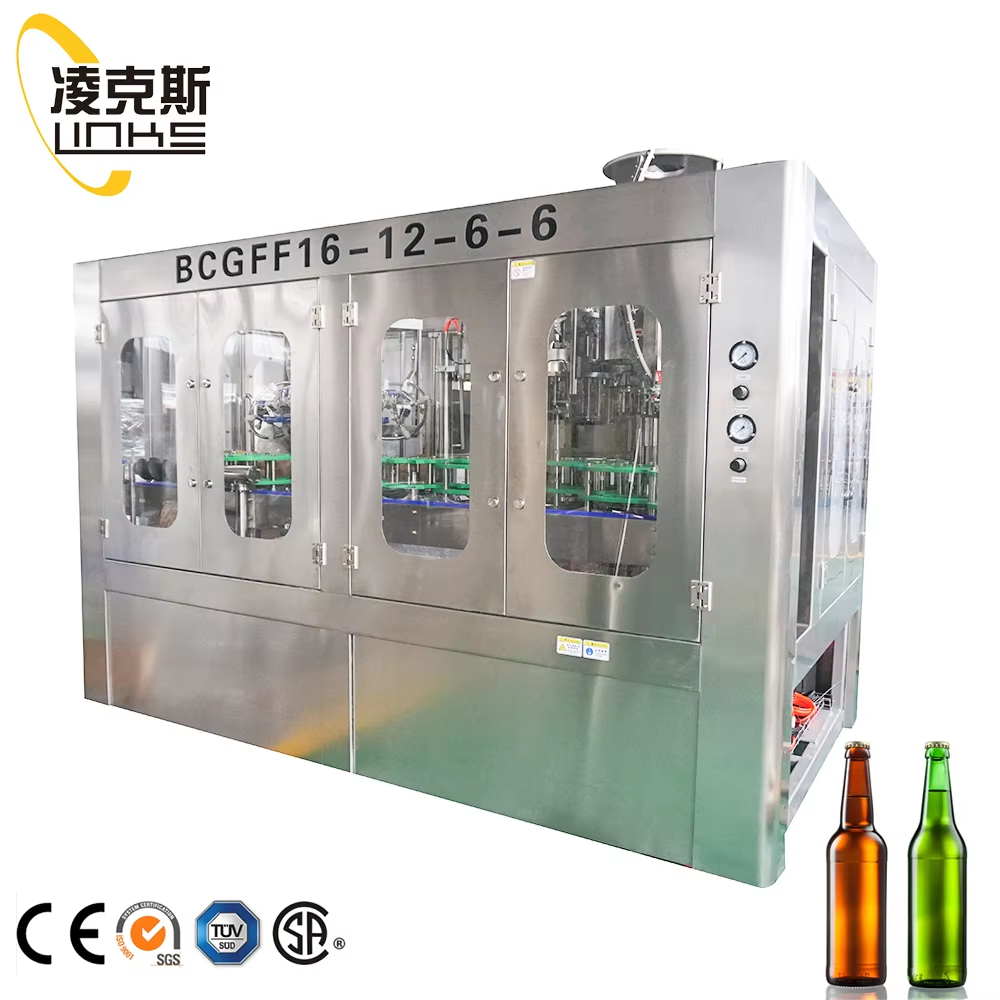
How Rotary Beer Filling Machines Ensure Exceptional Fill Accuracy
Isobaric (Counter-Pressure) Filling Technology for Carbonated Beer
Rotary beer filling machines use isobaric (counter-pressure) technology to preserve carbonation integrity during filling. Bottles are first pressurized with CO₂ to match the pressure inside the beer tank, eliminating foam formation caused by pressure differentials. This approach ensures 99.4% fill-level consistency and limits oxygen ingress to under 0.1 ppm—critical for flavor stability in hop-forward styles. The closed-system design supports full Clean-In-Place (CIP) sanitation without disassembly, mitigating microbial contamination risks. Modern systems incorporate vacuum-pressure sensors that auto-adjust gas flows during purging and filling, enabling seamless transitions across bottle sizes from 330 mL to 750 mL.
Real-Time Pressure Control and Servo-Driven Automation for ±0.5 mL Consistency
Servo-driven mechanisms precisely synchronize valve actuation with container positioning, achieving fill-volume tolerances of ±0.5 mL—roughly half a raindrop. Pressure transmitters sample vessel conditions 200 times per second, dynamically compensating for viscosity shifts in nitrogenated stouts or heavily dry-hopped IPAs. This real-time feedback prevents overfilling at high speeds (up to 120 BPM), avoiding the “gulping” effect common in linear fillers. Integrated mass flow meters verify volume during discharge, while rejection gates automatically remove underfilled containers. Combined with low-friction rotary motion, these systems sustain 0.1% fill accuracy over extended 16-hour production runs, per Brewing Industry International Research data.
Core Structural Design Advantages of Rotary Beer Filling Machines
Modular Rotary Platform Optimized for Beer-Specific Sanitation and CIP Compatibility
The circular turret design features interchangeable, stainless-steel modules engineered for hygiene and rapid reconfiguration. Crevice-free surfaces meet food-grade standards to inhibit microbial buildup—a key concern for beer shelf life. Integrated CIP systems circulate sanitizing solutions through all fluid pathways without disassembly, delivering 99.9% sterilization efficiency. Breweries can swap filling heads or capping stations in under 30 minutes when changing bottle formats, minimizing cross-contamination risk and preserving production agility. The fully enclosed architecture further shields against airborne contaminants during operation.
Seamless Infeed–Filling–Capping Integration Minimizing Product Loss and Oxidation
Continuous rotational motion synchronizes infeed, purging, filling, and capping within a single compact footprint. As bottles enter the carousel, they undergo inert-gas (e.g., CO₂) purging—reducing oxygen pickup to under 0.1 ppm, per ASBC (American Society of Brewing Chemists) benchmarks. Servo-controlled valves then execute counter-pressure filling while maintaining liquid temperatures below 2°C to protect carbonation. Immediately after filling, rotary cappers apply crowns or twist-offs while bottles remain sealed in the controlled atmosphere. This integrated workflow cuts product loss to just 0.3%, versus 2–5% spillage rates typical of linear systems, by eliminating transfer points where foam overflow commonly occurs.
Performance Validation: Throughput, Precision, and Brewery-Scale Reliability
Case Study: 99.8% Fill Volume Consistency at 120 Bottles per Hour in Craft Brewery Deployment
A recent craft brewery deployment achieved 99.8% fill volume consistency at 120 bottles per hour—maintaining variations within ±0.5 mL—through integrated servo automation and real-time pressure monitoring. This level of precision directly addresses industry data showing inconsistent fills contribute to ~12% of beverage recalls. For breweries, it reduces product loss by 3–5% compared to manual methods while ensuring compliance with regulatory fill-volume standards. The results confirm that modern rotary fillers deliver commercial-scale throughput without compromising measurement integrity—making them essential for quality-driven operations.
Why Brewers Choose Rotary Beer Filling Machines Over Linear Alternatives
Rotary beer filling machines dominate modern brewery operations due to their superior efficiency, precision, and space economy in high-volume environments. Unlike linear systems—which rely on start-stop motions, consume more floor space, and create bottlenecks—rotary configurations operate continuously as bottles rotate around a compact circular platform. This enables throughput exceeding 200% of comparable linear systems while sustaining ±0.5 mL fill accuracy via servo-controlled valves. Continuous motion also minimizes oxygen pickup during transfers, preserving carbonation and freshness critical to flavor integrity.
For carbonated beers, rotary machines integrate isobaric filling to maintain pressure equilibrium between tank and bottle—cutting foam-related waste by 15–20%, per industry benchmarks. Their modular architecture allows direct coupling with automated capping stations, removing intermediate handling steps that introduce contamination risk. While linear fillers offer niche flexibility for very small batches, rotary systems deliver the speed, oxidation control, and operational reliability required for commercial output exceeding 10,000 bottles per hour—solidifying their role as the operational backbone of modern brewing.