
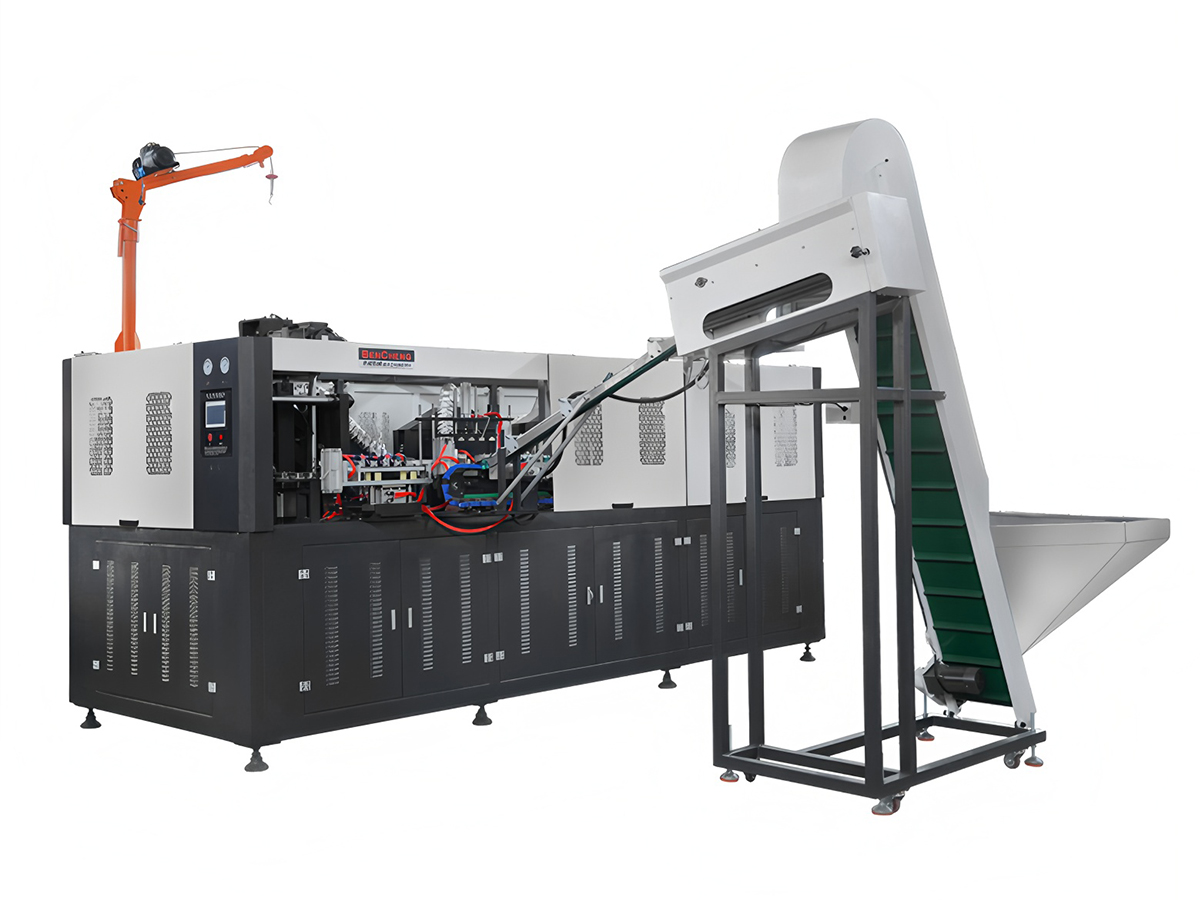
Precision Engineering in Blowing Machine Design
Servo-driven stretch rods for micron-level wall thickness uniformity
Modern blowing machines use servo-driven stretch rods to achieve micron-level wall thickness uniformity—essential for high-performance PET bottle production. Unlike pneumatic or hydraulic systems, servo motors deliver precise, repeatable control over speed, position, and force, eliminating mechanical lag and inconsistency. This enables balanced axial and radial stretching of the heated preform, yielding uniform wall distribution from neck to base. Consistent thickness improves structural integrity, burst strength, and top-load performance while enabling material reduction—no over-engineering for weak spots. Closed-loop position feedback continuously corrects deviations in real time, ensuring the stretch rod reaches exact depth targets for each mold cavity. The result is stable, high-cycle repeatability that lowers scrap rates and supports lightweighting without compromising quality—key for competitive, high-volume manufacturing.
Real-time closed-loop feedback systems correcting shape deviation during blow molding
Real-time closed-loop feedback systems maintain dimensional precision throughout the blow cycle by continuously monitoring temperature, pressure, and stretch rod position via embedded sensors. The central controller instantly adjusts blow pressure, stretch timing, and cooling rates to correct emerging defects—including uneven wall thickness, ovality, or base misalignment—before they solidify. For instance, localized low expansion triggers targeted air-flow increases without interrupting production. Advanced implementations integrate machine learning to recognize patterns in material behavior and preemptively fine-tune parameters. This intelligent responsiveness ensures bottles meet tight tolerances (e.g., ±0.1 mm) required by high-speed filling and capping lines—where minor deviations risk sealing failures. By closing the loop mid-cycle, manufacturers achieve both speed and consistency, transforming blow molding into a self-correcting, high-stability process.
Thermal and Pressure Control for Optimal PET Expansion
Zoned infrared heating with ±0.5°C uniformity to control preform crystallinity
Precise thermal conditioning is foundational to PET bottle quality: insufficient or uneven heating causes haze, stress-whitening, inconsistent wall thickness, or reduced burst strength. Modern zoned infrared heating divides the preform into multiple axial segments, each with independently controllable lamps. Maintaining ±0.5°C uniformity across zones is critical—deviations as small as 1.5°C disrupt crystallinity gradients and compromise clarity and mechanical performance. A 2023 study by the International Beverage Technologists Association confirmed that ±0.5°C control reduces crystallinity variation by 38% versus ±2°C systems, effectively eliminating stress-related visual defects. Heating profiles are tailored to preform geometry and resin grade to hit the optimal 95–115°C processing window—preserving neck rigidity while fully conditioning the base. This precision directly enables aggressive lightweighting: thinner walls retain drop-test and top-load performance only when formed from uniformly heated, optimally crystallized material.
Dual-stage high-pressure air delivery (up to 42 bar) with adaptive timing
Optimal PET expansion relies on a dual-stage blowing process: a low-pressure pre-blow (6–12 bar) initiates axial stretching, followed by a high-pressure final blow (up to 42 bar) that forces material into mold contours. Adaptive timing algorithms dynamically adjust stage duration and transition points using real-time sensor input—preventing off-center gates, base distortion, and thin-wall inconsistencies. According to the 2022 Packaging Automation Benchmark, this adaptive approach cuts material waste by 12% and improves base-thickness consistency by 18%, all while sustaining 40–42 bar capability for deep-draw or complex geometries. Rapid pressure recovery enables sub-2.5-second cycle times for 0.5-liter bottles—boosting throughput without sacrificing fidelity to mold detail or dimensional accuracy.
Smart Automation and Data-Driven Performance Optimization
IoT-enabled predictive maintenance reducing unplanned downtime by 27%
IoT-enabled predictive maintenance transforms blowing machine reliability by analyzing continuous sensor data—from stretch-blow station vibration and preform oven thermal imaging to compressed-air system pressure trends—to detect early signs of degradation. Subtle anomalies—like rising servo motor torque or gradual hydraulic oil temperature creep—are flagged before failure occurs. Instead of calendar-based servicing, maintenance is scheduled precisely when component wear thresholds are approached, extending service life and avoiding catastrophic stoppages. The 2023 Smart Manufacturing Benchmark reports a 27% reduction in unplanned downtime using this approach. Over time, machine learning refines prediction models using historical performance, optimizing spare-part logistics and technician deployment. Wireless connectivity and cloud analytics further enable remote diagnostics and rapid resolution—keeping OEE high and output quality consistent, cycle after cycle.
Integrated Blow Molding Workflow: From Preform to Precision Bottle
An advanced blowing machine orchestrates a tightly synchronized, end-to-end transformation—from raw preform to finished bottle—in a single, automated sequence. Preforms enter the machine and pass through precisely zoned infrared ovens calibrated to ±0.5°C, bringing the PET to its ideal forming temperature. A servo-driven stretch rod then extends to axially elongate the preform, while up to 42 bar of adaptive high-pressure air inflates it radially against the mold cavity. Real-time closed-loop sensors monitor and correct wall-thickness deviations within microns during this simultaneous stretch-and-blow phase. Rapid, controlled cooling locks in dimensional stability and optical clarity before ejection. Every stage—thermal conditioning, mechanical stretching, pneumatic forming, and thermal fixation—is governed by a unified control system, eliminating manual intervention and inter-stage variability. The result is a true precision instrument: one machine, one seamless workflow, delivering consistent weight, strength, clarity, and geometry at scale.
FAQ
What is the role of servo-driven stretch rods in blowing machines?
Servo-driven stretch rods ensure precise and repeatable control of wall thickness during PET bottle production, reducing material waste, improving structural integrity, and achieving high-quality outcomes in bottle manufacturing.
How does zoned infrared heating improve PET bottles?
Zoned infrared heating provides consistent temperature control across multiple segments of the preform, reducing stress-related defects and enabling precise thermal conditioning for optimal PET expansion.
What are the benefits of real-time closed-loop feedback systems?
These systems dynamically monitor and correct issues like wall thickness deviation, ovality, and base misalignment during production, ensuring tight tolerances and consistent product quality.
How does IoT-enabled predictive maintenance improve machine performance?
IoT-enabled maintenance detects early signs of component wear and enables predictive scheduling, reducing unplanned downtime by up to 27% and optimizing machine efficiency.
What does the dual-stage high-pressure air delivery system do?
This system ensures optimal PET expansion by initiating axial stretching at low pressure and finishing with high-pressure air, ensuring uniformity in thickness and mold fidelity.