
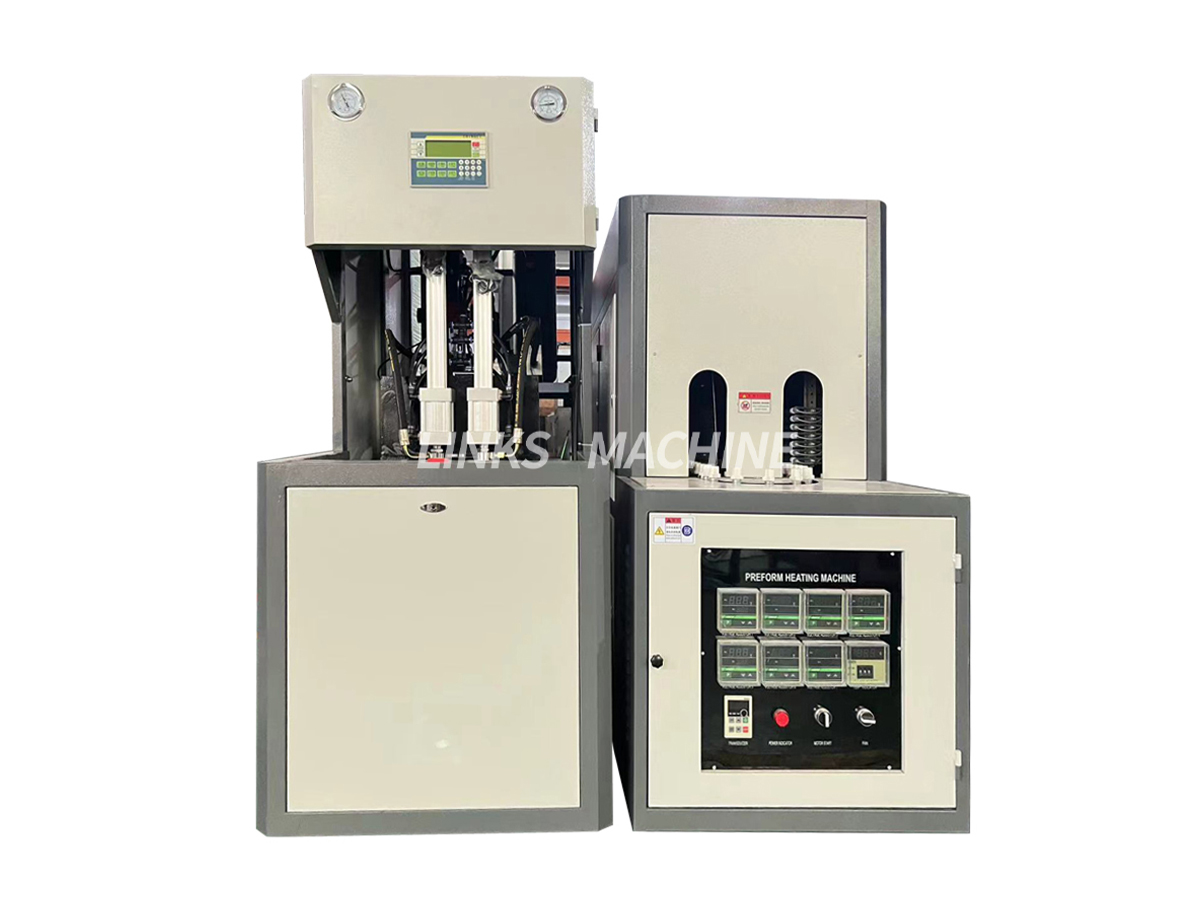
How Fully Automatic Blowing Machines Drive High-Volume Production Efficiency
Core Automation Architecture: Fixed-cycle, servo-driven control for consistent PET bottle formation
The core of a high-speed blowing machine is a fixed-cycle, servo-driven architecture that eliminates manual variability. Preforms are automatically oriented and fed into infrared ovens, heated to precise molding temperature, then transferred to the stretch-blow station. Servo motors govern the linear stretch rod and high-pressure air valves with sub-millisecond timing—ensuring identical mechanical and thermal treatment for every bottle. This closed-loop control maintains wall thickness and base clearance within micron-level tolerances, even at cycle times as low as 1.5 seconds. Finished containers are ejected directly onto the outfeed conveyor without operator intervention. Because the entire sequence—feed, heat, blow, eject—runs on a deterministic schedule, output remains consistent shift after shift, independent of operator skill. The result is a repeatable, waste-minimizing process that forms the foundation for high throughput and low defect rates in modern large-scale packaging operations.
Performance Benchmark: 32-cavity systems achieving 42,000 bottles/hour with <0.8% defect rate
Leading 32-cavity blowing machines deliver up to 42,000 bottles per hour—a throughput exceeding what multiple semi-automatic units achieve collectively—while maintaining a defect rate below 0.8%, as confirmed by 2023 packaging line audits published in the Packaging Machinery Benchmark 2023. This performance stems from integrated precision: automated vision systems inspect every bottle for ovality, stress-whitening, and base-split defects, rejecting non-conforming units before they reach the filler. Multicavity tooling and fast mold-change systems enable format switches in minutes—not hours—without sacrificing speed. Producers can therefore run multiple SKUs with minimal downtime, sustaining high overall equipment effectiveness (OEE) across shifts. The convergence of extreme speed, embedded quality control, and rapid changeover defines the 32-cavity system as the operational benchmark for cost-effective, high-volume PET bottle production.
Seamless Integration of Blowing Machines into End-to-End Packaging Lines
PLC-SCADA-MES synchronization for real-time cycle monitoring and predictive maintenance
Modern high-speed lines require tight integration between the blowing machine and surrounding equipment. Real-time data exchange is achieved by connecting the machine’s PLC to a SCADA system via industrial protocols like OPC UA or Ethernet/IP—capturing critical parameters such as blow pressure, preform temperature, and stretch timing every millisecond. SCADA aggregates this data and feeds it into an MES, creating a unified view of line performance. Continuous monitoring identifies micro-deviations signaling wear or incipient failure, enabling predictive algorithms to schedule maintenance before unplanned stoppages occur. Field data from integrated lines shows this closed-loop approach reduces unexpected downtime by up to 30% while preserving cavity-to-cavity consistency in bottle quality.
Modular design enabling plug-and-play connectivity with upstream fillers and downstream packers
Fully automatic blowing machines are built with modular construction to integrate seamlessly into existing packaging lines. Standardized mechanical interfaces and electrical connection points allow direct coupling to upstream fillers and downstream labeling, capping, and cartoning units. Common conveyor alignment and quick-change clamps reduce bottle format changeover to under 15 minutes. The control system is pre-configured to respond to the filler’s ejection signals and the packer’s accumulation sensors—ensuring smooth, bottleneck-free bottle flow. If a downstream jam is detected, the blowing machine pauses automatically, preventing scrap and wasted cycles. This synchronous, modular design supports scalable expansion and future upgrades without full-line replacement—making it a strategic enabler of adaptable, future-proof packaging infrastructure.
ROI and Operational Economics of Fully Automatic Blowing Machines
Quantified gains: 37% labor reduction and 22% energy savings versus semi-automatic blowing machines
A 2023 industry benchmarking study—the Packaging Machinery Efficiency Report—found that fully automatic blowing machines reduce direct labor requirements by 37% and cut energy consumption by 22% compared to semi-automatic alternatives. These gains arise from servo-driven automation that removes manual preform handling and enables continuous, idle-free operation. Advanced systems further optimize compressed air recovery and heating cycles, lowering energy use per bottle. Fewer operator interventions also reduce overtime, training overhead, and cycle-rate variability caused by human fatigue. In 24/7 high-volume facilities, these efficiencies compound rapidly—delivering six-figure annual cost reductions and shifting production from operator-dependent throughput to reliable, machine-paced output.
Breakeven analysis: CapEx payback in 18 months for operations exceeding 20 million units/year
For bottling plants producing more than 20 million units annually, the capital investment in a fully automatic blowing machine typically achieves payback within 18 months, according to a 2024 cost-analysis model developed by the Global Packaging Machinery Consortium. The calculation incorporates labor and energy savings, plus indirect benefits—including reduced scrap (from >2% rejection rates on semi-automatic lines to <0.8% on automated systems), lower rework, and decreased maintenance frequency. When deployed on high-utilization lines, the incremental output often commands premium pricing, accelerating ROI. By month 18, cumulative operational savings generally exceed the initial CapEx—after which the machine contributes pure margin improvement for the remainder of its service life.
Frequently Asked Questions
What are the key advantages of fully automatic blowing machines?
Fully automatic blowing machines provide consistent production, reduce defects, improve throughput rates, and enable high-volume PET bottle production with minimal waste and downtime.
How do these machines ensure bottle quality?
Integrated vision systems inspect every bottle for defects like ovality and stress-whitening, ensuring that only conforming units proceed through the packaging line.
What are the labor and energy savings compared to semi-automatic systems?
Fully automatic systems reduce labor needs by 37% and energy consumption by 22%, as confirmed by the Packaging Machinery Efficiency Report, 2023.
What is the typical ROI timeline for these machines?
Operations producing over 20 million units annually typically achieve ROI within 18 months due to labor, energy, and scrap reduction savings.
Can these machines integrate with existing packaging lines?
Yes, their modular design and standardized interfaces enable seamless integration with upstream and downstream equipment, providing a scalable solution for future expansion.