
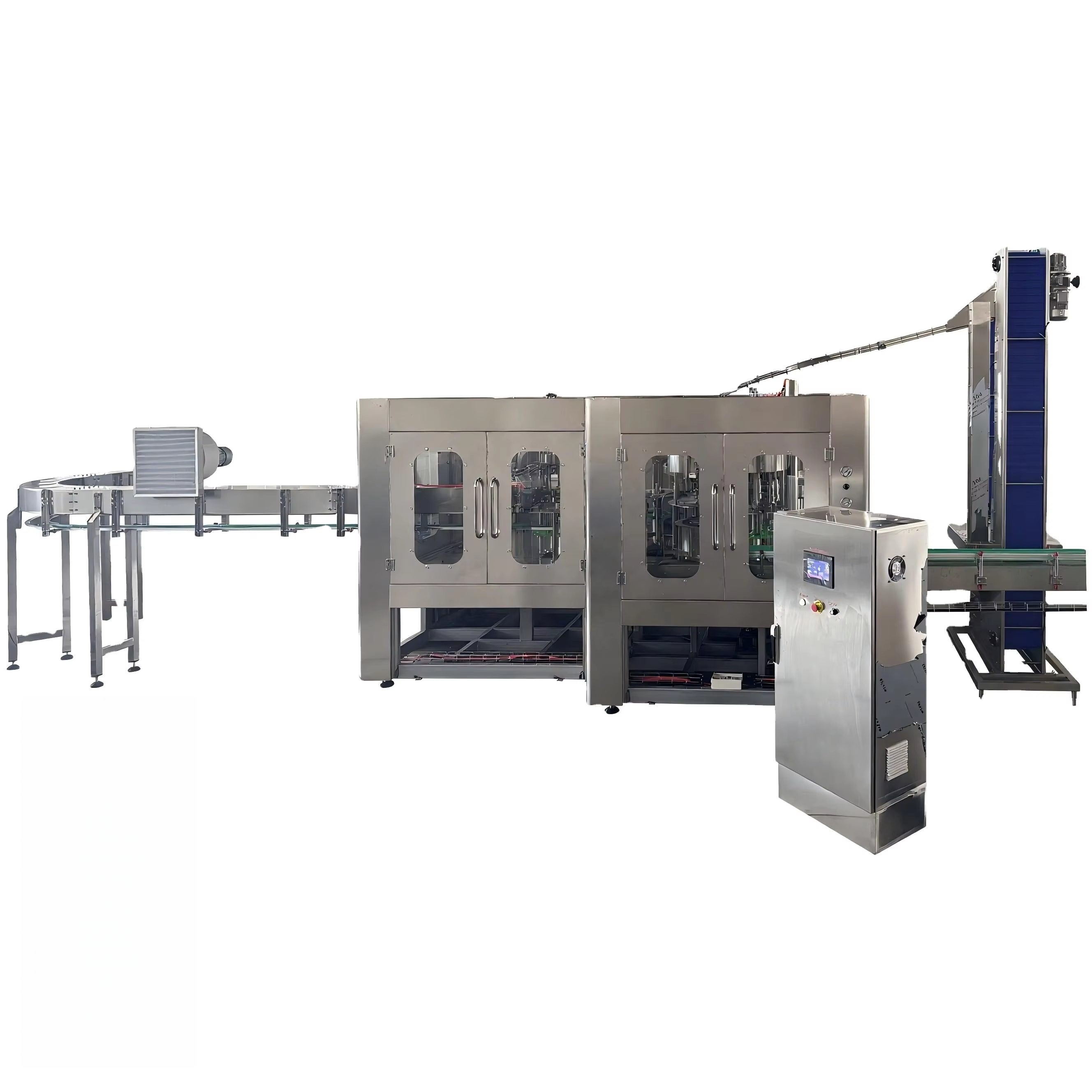
Core Isobaric Filling Technology for Precision Carbonation Retention
Why Foam Surge and CO₂ Loss Occur in Non-Isobaric Filling
When carbonated beverages are filled without pressure equalization, the sudden drop from tank pressure (typically 2–4 bar) to ambient conditions forces dissolved CO₂ out of solution—triggering foam surge, turbulence, and gas breakout. Gravity-based systems are especially vulnerable: liquid enters the bottle at atmospheric pressure while the beverage remains pressurized, destabilizing carbonation before filling even begins. Industry trials confirm non-isobaric soft drinks bottling lines retain only ~82% of original CO₂, resulting in inconsistent fizz, fill inaccuracies, and increased rework. Foam also delays capping, reducing line efficiency and requiring extended dwell times for settling.
How Counter-Pressure Valves and Vacuum Pre-Evacuation Enable Stable Isobaric Filling
Isobaric filling eliminates this pressure mismatch by equalizing internal bottle pressure with the product reservoir before liquid transfer. A standardized three-phase sequence ensures stability: (1) vacuum or CO₂ flush removes ambient air; (2) CO₂ injection raises internal pressure to within ±0.1 bar of the filler bowl (typically 2.5–3.5 bar); and (3) laminar flow begins under sustained counter-pressure. The counter-pressure valve maintains equilibrium throughout the cycle, preventing gas nucleation and foam formation. Modern systems achieve >98% pressure uniformity across all bottles—even at speeds exceeding 600 bpm—while PID-controlled backpressure compensation holds dissolved CO₂ variance to ≤0.15 g/L despite line fluctuations.
Real-World Performance: Leading Filler at 32,000 bph with <0.5% CO₂ Loss
A high-speed isobaric filler deployed in premium soft drinks bottling achieves 32,000 bottles per hour while limiting total CO₂ loss to under 0.5%—retaining 97.3% of initial carbonation versus 82% in non-pressurized systems. Its multi-stage pre-evacuation and dynamic counter-pressure valve array ensure consistent mouthfeel and effervescence across every unit. Dual gas reservoirs and automated pressure compensation maintain integrity during start-up, speed ramping, and changeovers—eliminating the need for recalibration or manual intervention. This reliability has cemented isobaric filling as the industry standard for quality-critical carbonated beverages.
Carbonation Integration Methods in Soft Drinks Bottling Lines
Three primary methods integrate carbonation into beverages during soft drinks bottling: inline, tank, and bottle carbonation. Each balances CO₂ transfer efficiency, consistency, scalability, and facility constraints—making the optimal choice dependent on production volume, product portfolio, and infrastructure.
Inline Carbonation: High-Efficiency CO₂ Transfer for Continuous Soft Drinks Bottling
Inline carbonation injects food-grade CO₂ directly into the beverage stream immediately upstream of the filler, leveraging turbulent flow and precise residence time to achieve 95–98% gas transfer efficiency. Because it operates continuously in a closed loop, it delivers tight carbonation control (±0.1 volumes CO₂), minimizes gas waste, and supports high-speed operations exceeding 30,000 BPH without batch lag. Its compact footprint and real-time adjustability make it ideal for large-scale, single-SKU or limited-variant lines where consistency and throughput are paramount.
Tank vs. Bottle Carbonation: Trade-offs in Consistency, Scalability, and Equipment Footprint
Tank carbonation saturates beverage batches in agitated, pressurized vessels prior to filling—ensuring high uniformity and scalability but demanding significant floor space for tank farms and longer lead times for recipe changes. Bottle carbonation introduces CO₂ post-filling via needle injection or diffusion, drastically reducing infrastructure requirements but introducing greater per-unit variability (±0.3 volumes CO₂) due to differences in bottle geometry, temperature, and residual headspace.
| Method | Consistency | Scalability | Equipment Footprint |
|---|---|---|---|
| Tank Carbonation | High | High | Large (tank space) |
| Bottle Carbonation | Moderate | Low | Compact |
Tank systems remain the benchmark for standardized, high-volume production (e.g., cola variants), while bottle carbonation suits small-batch craft sodas or functional beverages where flexibility and lower capital investment outweigh the need for absolute carbonation uniformity.
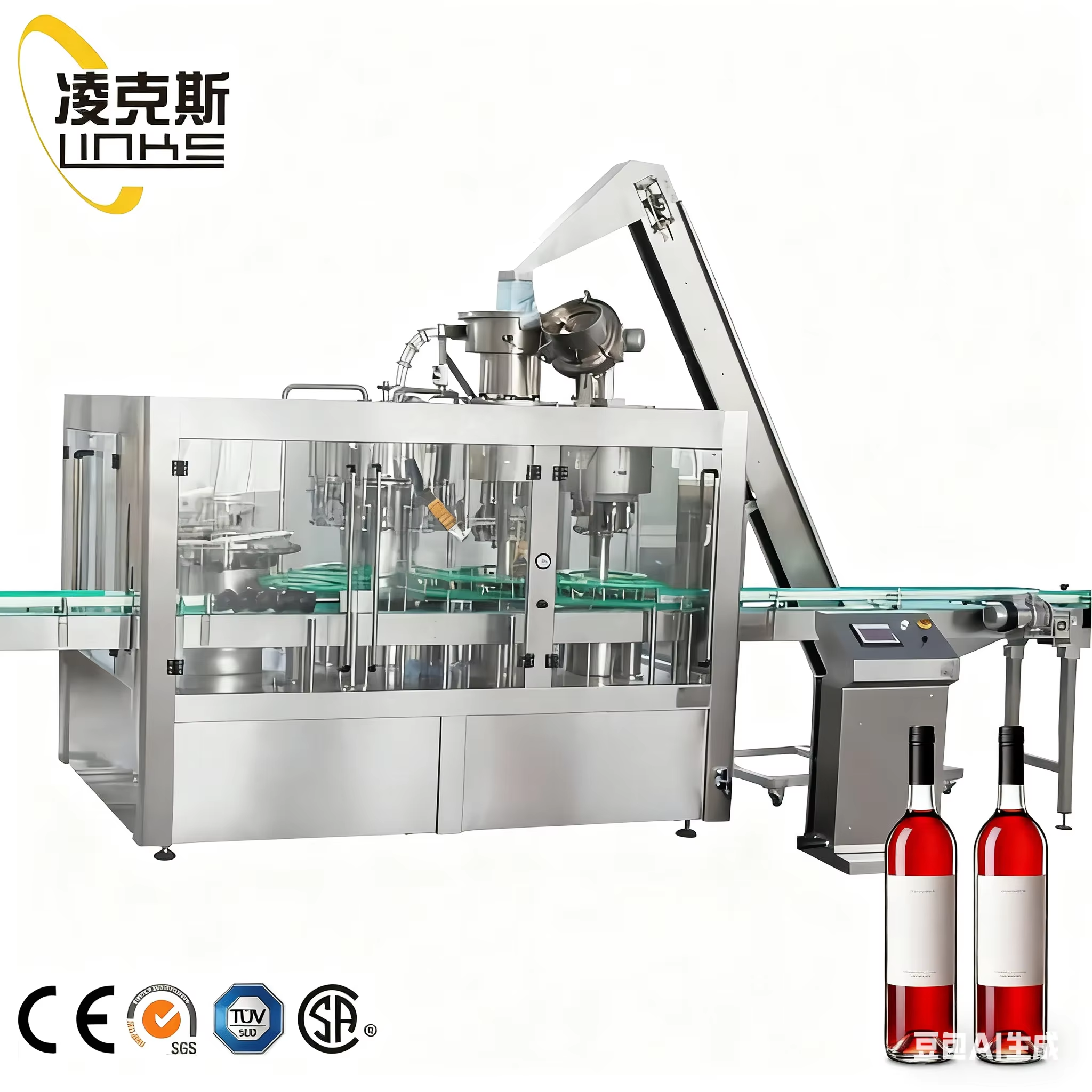
Contamination Control in High-Speed Carbonated Soft Drinks Bottling
Microbial Risks During PET Bottle Handling and Rinsing
PET preforms and bottles are highly susceptible to airborne microbial contamination—especially during high-speed conveying, heating, and blow-molding. Dust, spores, yeast, and bacteria can adhere to inner surfaces and survive subsequent rinsing if not rigorously controlled. Humidity and temperature variations during storage further promote biofilm formation, increasing the risk of spoilage, off-flavors, or accelerated CO₂ loss in the final product.
Sterile Air Rinsing, Ozone-Treated Water, and ATP Monitoring for CSD Safety
Modern carbonated soft drinks (CSD) lines deploy a validated triad of contamination controls: sterile, filtered air rinsing dislodges particulates and reduces microbial load before liquid contact; ozone-treated water provides broad-spectrum disinfection without chemical residues or rinse-water carryover; and ATP bioluminescence testing delivers real-time surface cleanliness verification—ensuring organic residue remains below 10 RLU (relative light units) on critical contact surfaces. Together, these measures maintain microbial counts well below FDA and EFSA thresholds, preserving product safety, shelf life, and carbonation integrity.
FAQ
What is the main issue with non-isobaric filling in carbonated beverages?
Non-isobaric filling causes a pressure drop from 2–4 bar to atmospheric pressure, leading to CO₂ loss, foam surge, and turbulence, which ultimately destabilize carbonation.
How does isobaric filling maintain carbonation stability?
Isobaric filling equalizes bottle pressure with the product reservoir to prevent gas nucleation or foam formation, ensuring carbonation retention and fill accuracy.
What are the advantages of inline carbonation?
Inline carbonation offers high CO₂ transfer efficiency (95–98%), tight carbonation control (±0.1 volumes CO₂), and suitability for high-speed operations exceeding 30,000 BPH.
What are the key differences between tank and bottle carbonation?
Tank carbonation provides high consistency and scalability but requires significant space. Bottle carbonation is more compact but introduces greater variability in CO₂ levels.
How can microbial contamination be controlled in PET bottling?
Microbial risks can be managed using sterile air rinsing, ozone-treated water, and ATP bioluminescence testing to ensure cleanliness below 10 RLU on critical surfaces.
Table of Contents
- Core Isobaric Filling Technology for Precision Carbonation Retention
- Carbonation Integration Methods in Soft Drinks Bottling Lines
- Contamination Control in High-Speed Carbonated Soft Drinks Bottling
-
FAQ
- What is the main issue with non-isobaric filling in carbonated beverages?
- How does isobaric filling maintain carbonation stability?
- What are the advantages of inline carbonation?
- What are the key differences between tank and bottle carbonation?
- How can microbial contamination be controlled in PET bottling?