
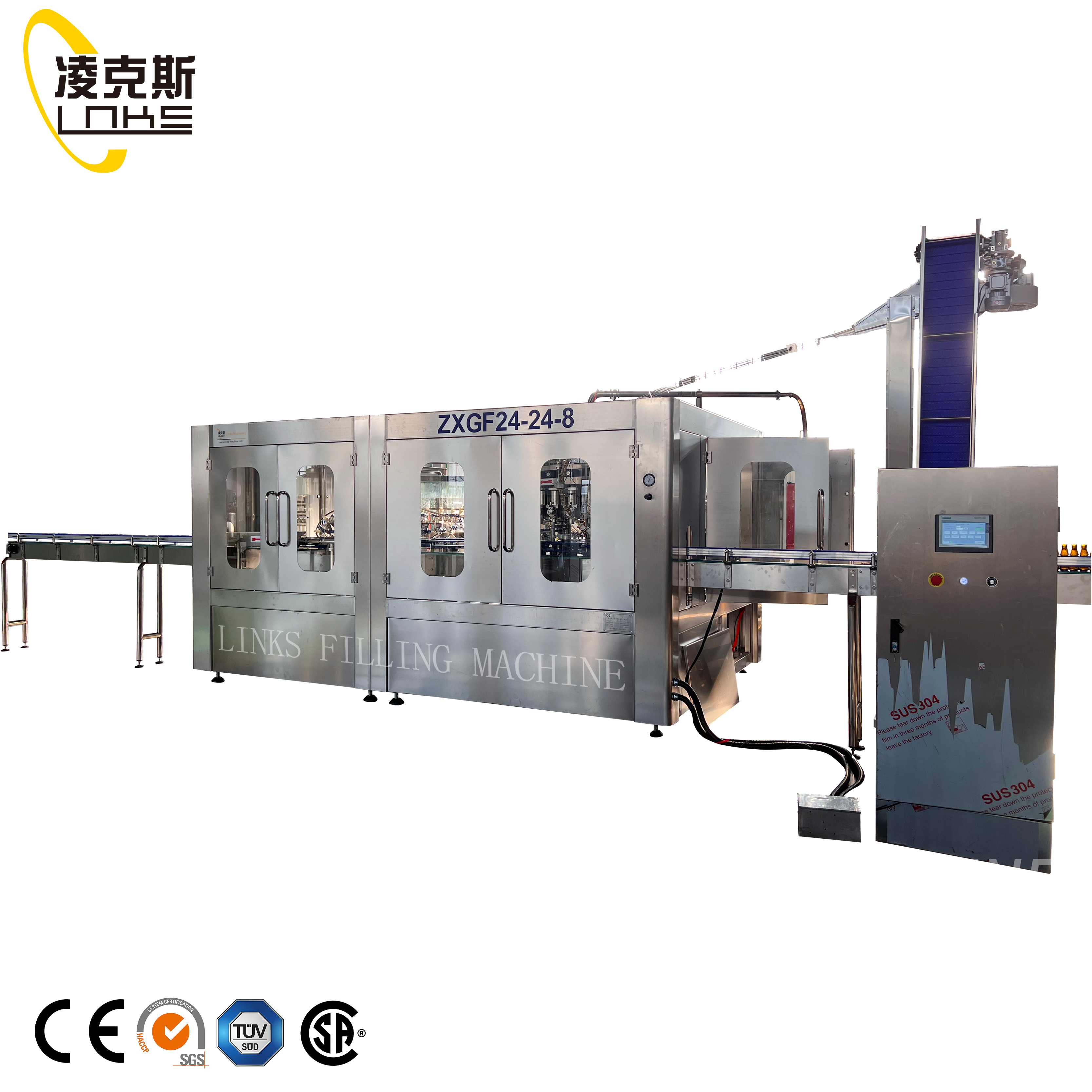
How Bottle Filling Machines Work: Technology and Applications in the Beverage Industry
Core mechanisms of liquid bottle filling machines: Gravity, piston, and pressure-based systems
Today's bottle filling equipment typically employs three main approaches to get just the right amount of liquid into each container. The gravity method works by letting the product's own weight do the job, which makes sense for things like plain water that doesn't foam up when poured. For thicker substances such as syrup or juice, piston fillers come into play since they measure volume precisely, often hitting within plus or minus 1 percent accuracy. Then there's pressure filling, specifically made for fizzy drinks. These systems push the liquid into bottles under controlled conditions so the bubbles stay intact. Most setups keep carbon dioxide levels around 3.5 to 5.5 grams per liter to maintain that satisfying fizz without losing too much during the process.
Matching filling method to product type: Carbonated drinks, still water, juices, and viscous liquids
When it comes to carbonated drinks, manufacturers need to use counter pressure filling methods to stop all that pesky foaming. The machinery involved typically maintains around 1.8 to 2.5 bar of internal pressure while running. For plain still water and other thin liquids, gravity systems work just fine and can crank out about 300 bottles every minute. Things get trickier with pulpy juices and thick smoothies though. These require special piston fillers capable of handling viscosities as high as 15,000 centipoise without messing up the product consistency. And then there's the whole temperature issue. Dairy based drinks for instance really need those chilled filling chambers that operate between 3 and 7 degrees Celsius. This cold environment helps keep everything fresh and stops unwanted bacteria growth, which is obviously super important for food safety standards.
Operational workflow from container infeed to precise fill completion
Automated lines process bottles through six critical phases:
- Infeed conveyor alignment: Orients containers at 15–20 m/min for accurate positioning
- Nozzle engagement: Seals filler heads to bottle necks with 2–5 Nm torque
- Volumetric dispensing: Delivers fills accurate to ±2 mL in pressurized systems
- Gas purging: Removes oxygen from beer and wine bottles, maintaining <0.5% O₂ levels to preserve flavor
- Cap placement: Applies closures within 0.5-second intervals at high-speed stations
- Quality verification: Laser sensors check fill heights with 0.1 mm resolution
Advanced PLC systems monitor each phase, automatically adjusting parameters when production exceeds 18,000 bottles/hour, ensuring seamless continuity.
Speed, Accuracy, and Consistency in High-Performance Bottle Filling
High-Speed Bottle Filling Benchmarks: Achieving Up to 24,000 Bottles/Hour Without Compromising Quality
Modern rotary filling machines achieve speeds of up to 24,000 bottles per hour using multi-nozzle configurations and synchronized conveyors. This efficiency allows beverage producers to meet high demand while maintaining tight profit margins. Parallel filling stations reduce idle time, enabling continuous operation even during container changes or format transitions.
Precision Engineering: Maintaining ±0.5% Fill Accuracy Across Batches
Fill accuracy is essential for regulatory compliance and cost control. Advanced volumetric systems achieve tolerances as low as ±0.5% through precision engineering:
| Technology | Accuracy Range | Ideal Use Case |
|---|---|---|
| Servo-controlled pistons | ±0.1–0.3% | Pharmaceuticals, juices |
| Pressure-based overflow | ±0.5–1% | Carbonated beverages |
| Gravimetric systems | ±0.2–0.5% | Viscous liquids |
Real-time viscosity sensors adjust flow rates within milliseconds, minimizing underfills during turbulent transfers and enhancing batch consistency.
Balancing High-Volume Output With Consistent Fill Levels Under Real-World Production Conditions
Top-tier systems maintain 99.4% fill consistency across 100,000-bottle runs using predictive pressure algorithms and self-calibrating nozzles. Dual-stage verification—optical and volumetric—ensures only accurately filled containers proceed, with less than 0.01% product waste. These capabilities allow manufacturers to scale output seamlessly, even when switching between bottle sizes or liquid types mid-run.
Automation and Integration: Smart Controls in Modern Filling Systems
PLC and HMI-driven automation: Real-time monitoring and operational control
In modern filling operations, Programmable Logic Controllers (PLCs) work hand in hand with Human-Machine Interfaces (HMIs) to create precise coordination across production lines. These PLCs handle information coming from around twenty different sensors on each line, making adjustments to valves, motors, and various actuators almost instantly when something goes off track—typically within just five milliseconds after noticing any deviation. For operators managing these systems, touchscreens have become essential tools for controlling everything from fill volumes to viscosity settings and even line speeds. This digital interface cuts down setup times significantly compared to older manual methods, saving about thirty percent according to recent industry reports from Packaging Digest back in 2023.
Seamless line integration: Synchronizing fillers with capping, labeling, and conveyance systems
The high performance fillers work hand in hand with equipment further down the line, syncing up every 0.1 seconds or so through EtherCAT protocols. This close connection keeps things moving smoothly regardless of whether we're dealing with small 150ml containers or larger 2 liter ones, even when switching between different sizes. For the capping process, pressure sensors automatically tweak the torque depending on how thick the material is. Meanwhile, special reject arms kick out any bottles that aren't filled properly at a speed of 2.4 meters per second all while keeping the production line running without interruption.
Case data: Servo-driven rotary fillers from ZHANGANGJIAGANG LINKS MACHINE CO LTD deliver speed and precision
Servo-driven rotary fillers demonstrate exceptional performance, achieving 99.8% fill accuracy for carbonated beverages over 18-hour runs. Direct-drive technology eliminates gear backlash, allowing format changes in under seven minutes—60% faster than conventional models. Manufacturers report a 23% increase in daily output after adoption (Food Engineering 2024).
| Metric | Traditional Fillers | Servo-Driven Fillers | Improvement |
|---|---|---|---|
| Changeover Time | 18 minutes | 7 minutes | 61% Faster |
| Daily Output | 192,000 bottles | 235,000 bottles | 23% Higher |
| Fill Accuracy Tolerance | ±1.2% | ±0.5% | 58% Tighter |
Hygiene, Durability, and Compliance in Food-Grade Filling Equipment
Stainless steel construction and sanitary design: Meeting food safety regulations
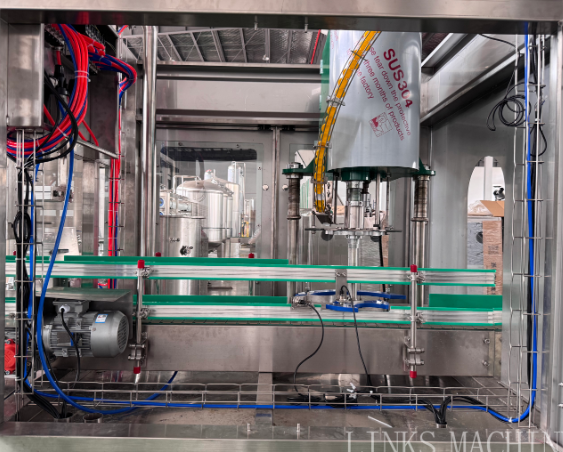
Most food grade filling machines rely on either 304 or 316 stainless steel materials, these two types cover around 90% of all hygienic applications because they resist corrosion and are easy to clean according to recent industry reports. The surfaces get electropolished treatment and joints are welded orbitally to reduce places where bacteria might hide, helping manufacturers meet those tough FDA 21 CFR requirements as well as EHEDG guidelines. When it comes to sanitary design, manufacturers focus on things like angled surfaces that drain properly, clamps that come apart quickly when needed, and parts without any tight corners or gaps where contaminants could stick around. These features make cleaning much easier and stop different products from mixing together during production cycles. For stuff like milk products, various sauces, and drinks with high acidity levels, keeping microbial counts under 2 colony forming units per square centimeter becomes absolutely critical for safety reasons.
Clean-in-place (CIP) systems: Ensuring hygiene and minimizing downtime
CIP systems that are automated can cut down on cleaning time by around 40%, thanks to their ability to program how detergents circulate throughout the system. These systems manage to eliminate about 99.9% of stubborn biofilms without needing to take anything apart, according to research from the Sanitation Efficiency Study in 2023. Most facilities follow a basic four step process when it comes to cleaning: first they do a quick rinse, then apply caustic solutions, next neutralize acids, and finish off with another thorough rinse. This helps maintain clean conditions especially important when switching between different flavors or handling products sensitive to allergens. When connected to PLC controls, these cleaning systems keep track of all the wash cycles which makes audits much easier. Plus, they recover roughly 85% of both water and cleaning agents for future use, making them pretty good for the environment overall.
Scalability and Flexibility: Adapting Bottle Filling Machines for Business Growth
From Craft Producers to Large-Scale Plants: Selecting Scalable Filling Solutions
Today's filling equipment is built with modular designs so manufacturers can boost production capacity by around 3 to 5 times without having to replace the whole system. Take small craft breweries for instance those making about 5,000 bottles per day often start with basic setups but can later add more filler heads or upgrade their conveyor belts as demand grows. The good news is these machines come with standard connections that make it easy to expand operations down the road. Breweries might want to install automated inspection stations next or integrate other quality control features as standards change over time. This flexibility helps businesses adapt without breaking the bank on completely new machinery every few years.
Quick-Change Tooling and Format Flexibility: Handling Multiple Bottle Sizes Efficiently
Modern servo driven systems can switch formats in less than five minutes thanks to their self adjusting grippers and adjustable height width parameters. This kind of adaptability means manufacturers can run both small 250ml energy drink bottles alongside larger 2 liter family packs right on the same production line. And it's not just convenience either most beverage companies today actually need this capability since around three out of four brands now sell products in at least three different packaging sizes according to IBWA data from last year. The system also comes equipped with quick disconnect clamps and various tool free adjustment options which significantly reduces the time lost during equipment reconfiguration typically cutting down downtime by roughly forty percent across the board.
Case Study: Modular Retrofit Enables Juice Producer to Double Output Without Facility Expansion
A juice maker down in Florida recently gave their old filling system a serious upgrade by installing a rotary monoblock that does filling, capping, and labeling all in one go. They spent around $280k on this overhaul which they managed to finish in just one weekend. What used to take three separate machines now fits into one compact setup, clearing up about 600 square feet of valuable factory floor space. Production has shot up by an impressive 124% since the switch. The new line can handle twelve different product types ranging from small 8 ounce tetra packs right up to big 64 ounce glass bottles. Pretty remarkable too considering they maintain almost perfect fill accuracy at 99.2% across every format they produce.
FAQs
What are the main types of bottle filling machine systems?
The primary types include gravity-based systems, piston fillers, and pressure filling systems. Each system is designed for specific liquid characteristics, such as viscosity and carbonation.
How do bottle filling machines handle different liquid types?
For carbonated drinks, pressure filling systems are used to prevent foaming. Thin liquids like water use gravity systems, while thicker liquids like juices require piston fillers for accurate volume measurement.
What role do PLCs and HMIs play in bottle filling machines?
PLCs (Programmable Logic Controllers) and HMIs (Human-Machine Interfaces) ensure precise operations and monitoring by coordinating different components and making real-time adjustments during the process.
How is fill accuracy maintained in high-speed operations?
Advanced volumetric systems and real-time viscosity sensors ensure a fill accuracy of up to ±0.5%, using technologies like servo-controlled pistons and pressure-based overflow systems.
Are there considerations for hygiene in bottle filling machines?
Yes, materials like 304 or 316 stainless steel are used for hygiene. Features like clean-in-place (CIP) systems also ensure automated cleaning and hygiene compliance.
Table of Contents
- How Bottle Filling Machines Work: Technology and Applications in the Beverage Industry
- Speed, Accuracy, and Consistency in High-Performance Bottle Filling
- Automation and Integration: Smart Controls in Modern Filling Systems
- Hygiene, Durability, and Compliance in Food-Grade Filling Equipment
- Scalability and Flexibility: Adapting Bottle Filling Machines for Business Growth
-
FAQs
- What are the main types of bottle filling machine systems?
- How do bottle filling machines handle different liquid types?
- What role do PLCs and HMIs play in bottle filling machines?
- How is fill accuracy maintained in high-speed operations?
- Are there considerations for hygiene in bottle filling machines?